Michigan’s Largest Jeweler
◆
Celebrating 50 Years in 2026 (Look out for our massive Golden 51st Anniversary in 2027)
◆
Easy Payment Options Click Here
◆
Free Standard Shipping on all US Orders Over $199
◆
Book a Personal Shopping Appointment Click Here
◆





How to Choose a Ring Enhancer That Fits Your Engagement Ring

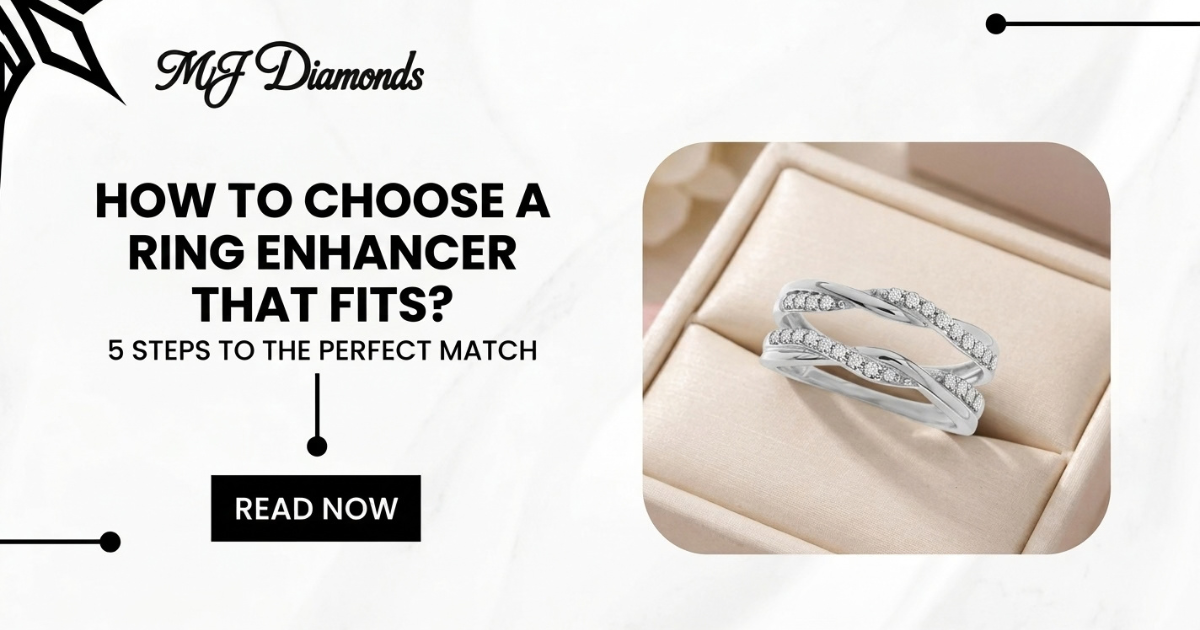
You love your engagement ring. But maybe it looks a little plain on its own. Or maybe you want a fresh look for an anniversary. A ring enhancer can add sparkle and width without changing the ring you already wear.
There is one catch. A ring enhancer only looks great when it fits. If the shape is wrong, you see gaps. If the size is wrong, it spins or pinches. If the metal is wrong, the two rings can look mismatched.
This guide shows you how to pick one that fits, one step at a time. You do not need to know anything about jewelry. By the end, you will know exactly what to check before you buy.
The Short Answer
A ring enhancer fits best when it matches four things on your engagement ring: the shape of the center diamond, the height of the setting, the metal, and the ring size. When all four match, the two rings sit together like one ring.
The center diamond is the big stone in the middle. The setting is the metal that holds it.
What Is a Ring Enhancer?
A ring enhancer is a band that hugs your engagement ring. Many people also call it a ring wrap or a ring jacket. It adds extra diamonds and width, so a simple ring looks fuller and bigger.
Here are the two most common styles:
- Wrap: One curved band that bends around the center diamond. It puts small diamonds on both sides of the big one.
- Insert style: A split band with a gap in the middle. Your engagement ring slides into that gap.
A ring guard is a close cousin. Its main job is to keep your ring snug so it stops spinning. You can see that style on our ring guards page. If you want the full difference between a wrap, an enhancer, and a guard, visit our page on ring wraps and enhancers. This guide answers a different question: how do you know if one will fit?
Step 1: Match the Shape of Your Center Diamond
This is the most important step. Enhancers are cut to curve around a certain stone shape. If the curve does not match your stone, you will see gaps between the two rings.
Use this chart to see what to look for.
| Center stone shape | What to look for | Common fit problem |
| Round | Most enhancers are made for this shape, so you have the most choices | Very few. Just check the setting height |
| Oval | A deeper, longer curve made for oval stones | A round curve leaves gaps near the tips |
| Princess (square) | A squared opening or a straight-across design | A round curve leaves gaps at the corners |
| Cushion (soft square) | A softer curve made for a rounded square | A round or square curve can leave small gaps |
| Pear or marquise | Ask a jeweler first. These often need a special fit | Pointed ends may not line up with the enhancer |
If you are not sure of your stone shape, ask a jeweler. They can tell you in seconds. Still deciding on a shape for a new ring? Our guide to oval vs round engagement rings can help.
The best test is simple. Bring your engagement ring to the store and try the enhancer on with it. A photo can hide gaps that you will see right away in person.
Step 2: Check the Height of Your Setting
Look at your ring from the side. Does the diamond sit high above your finger? Or does it sit low, close to the band? This is called setting height, and it changes how an enhancer looks.
- A high setting has tall metal claws, called prongs, that lift the diamond up. A thin enhancer can look small next to it. It may also leave a gap under the stone.
- A low setting keeps the diamond close to your finger. A thick enhancer can sit as tall as the center stone and pull the eye away from it.
You want the enhancer to sit close to the center stone without rising above it or hiding it. Ask your jeweler to check the width and height of your setting. Then compare that to the enhancer you like.
Here is a quick tip. Take a photo of your ring from the side. Show it to the jeweler. It helps them pick a style that lines up with your diamond.
Step 3: Match the Metal
Most engagement rings are yellow gold, white gold, or rose gold. Pick an enhancer in the same color. A yellow gold enhancer next to a white gold ring will look off, even if the diamonds are perfect.
If you can, match the karat too. Karat tells you how much pure gold is in the metal. For example, 14K gold with 14K gold is a good match.
There is another reason to match. Your two rings will touch each other all day. Metal that rubs against metal wears down over time. When both rings are made from similar metal, they tend to wear at a similar pace. If you must mix metals, ask your jeweler how the two will wear together.
White gold has one more thing to know. Many white gold rings have a bright, shiny coating. Over time the coating fades. If your engagement ring is a few years old, a brand new white gold enhancer may look a little brighter next to it. That is normal. A jeweler can freshen up the older ring so both look the same.
Step 4: Get the Ring Size Right
Your enhancer should be the same ring size as your engagement ring. That sounds easy, but there are a few things to watch.
- Use the size you already wear. If your engagement ring fits well, use that size.
- Check your finger at the right time. Fingers get bigger when it is warm and smaller when it is cold. They are also a little bigger later in the day.
- Try both rings on together. Two rings can feel tighter than one. Wear them for a few minutes to see how they feel.
Ask about resizing before you buy. Some enhancers have diamonds set around the band, and that can make resizing hard. Some cannot be resized at all. It is much easier to get the right size on day one. MJ Diamonds offers ring sizing, so ask our team what is possible for the piece you like.
Step 5: Pick the Amount of Sparkle and Comfort
Now for the fun part. Once the fit is right, choose the look you love.
How many diamonds? Some enhancers have diamonds only on the top. Others have diamonds most of the way around. More diamonds means more sparkle and usually more width.
How wide should it be? A thin enhancer looks light and simple. A wide one looks bold. Think about your hands. If you have small fingers, a very wide band may feel heavy.
How do you use your hands? If you type, cook, lift weights, or work with tools, choose a smooth and low style. Rings that sit low snag less on clothes and gloves.
Do you want to add more rings later? If you like the idea of a stack, check out our stackable rings. You can also shop ladies diamond bands to see what else pairs well.
Do You Still Need a Wedding Band?
Not always. There are three common ways to wear an enhancer.
- As your wedding band. Some people wear the enhancer with the engagement ring as their main set.
- With a wedding band. Others wear all three, with the band on the other side of the engagement ring.
- As an anniversary gift. Many people add an enhancer later, for a special year.
If you are still picking rings, look at our bridal collection and trio sets. They show how engagement rings and bands look together.
Five Common Mistakes to Avoid
Here are the most common problems we see, and how to skip them.
- Buying from a photo only. Pictures hide gaps. Try the rings on together whenever you can.
- Ignoring the stone shape. A round enhancer will not hug an oval or square stone.
- Skipping the side view. A ring can look perfect from above and leave a gap from the side.
- Mixing metal colors by accident. Check the color and karat before you decide.
- Forgetting about resizing. Ask about it early, before your fingers change or you buy the wrong size.
What to Bring to the Jeweler
A little prep makes shopping faster and easier. Bring these things:
- Your engagement ring, so you can try on the enhancer with it
- Your ring size, if you know it
- A side photo of your ring
- A budget range
- A short list of questions
Here are some good questions to ask:
- Will this fit my center stone shape?
- Will it sit close to my setting without a gap?
- Is the metal a good match for my ring?
- Can it be resized later?
- How do I clean two rings that sit tight together?
The last question matters. Two rings that sit close can trap dirt between them. MJ Diamonds offers free jewelry cleaning, so you can bring your rings in and keep them shining.
A Quick Word on Guards and Enhancers
You may see the words guard, wrap, and enhancer used as if they mean the same thing. They overlap, but they are not always the same. A guard is mostly for fit and protection. An enhancer is mostly for looks. A wrap is one style of enhancer.
If your ring spins a lot, look at a ring guard. If you want more sparkle, look at a wrap or enhancer. You can also browse our page for ladies wraps and enhancers.
Frequently Asked Questions
Will any ring enhancer fit my engagement ring?
No. An enhancer must match your center stone shape, your setting height, and your ring size. The metal color should match too. If even one of these is off, you may see gaps or feel the rings pinch.
What size ring enhancer should I buy?
Buy the same size as your engagement ring. Try both rings on together before you decide. Two rings can feel tighter than one, so wear them for a few minutes.
Can I wear a ring enhancer without a wedding band?
Yes. Many people wear an enhancer as their wedding band. Others add a band later or wear all three rings together. There is no rule, so pick what you like best.
Will a ring enhancer make my diamond look bigger?
It can make the whole ring look bigger and fuller. The extra diamonds add width and sparkle around your center stone. It does not change the size of the center diamond itself.
Can I use an enhancer with a halo ring?
Usually not. A halo ring already has small diamonds around the center stone. An enhancer may not sit close to it. A plain band is often a better match. Ask a jeweler to check your ring before you buy.
Is a ring enhancer the same as a ring guard?
They are close, but not the same. A ring guard is mainly for fit and protection. It helps a loose ring stop spinning. An enhancer is mainly for looks. It adds diamonds and width. Some pieces do both jobs.