Michigan’s Largest Jeweler
◆
Celebrating 50 Years in 2026 (Look out for our massive Golden 51st Anniversary in 2027)
◆
Easy Payment Options Click Here
◆
Free Standard Shipping on all US Orders Over $199
◆
Book a Personal Shopping Appointment Click Here
◆





Diamond Stud Size Chart: What 1 Carat Looks Like on the Ear

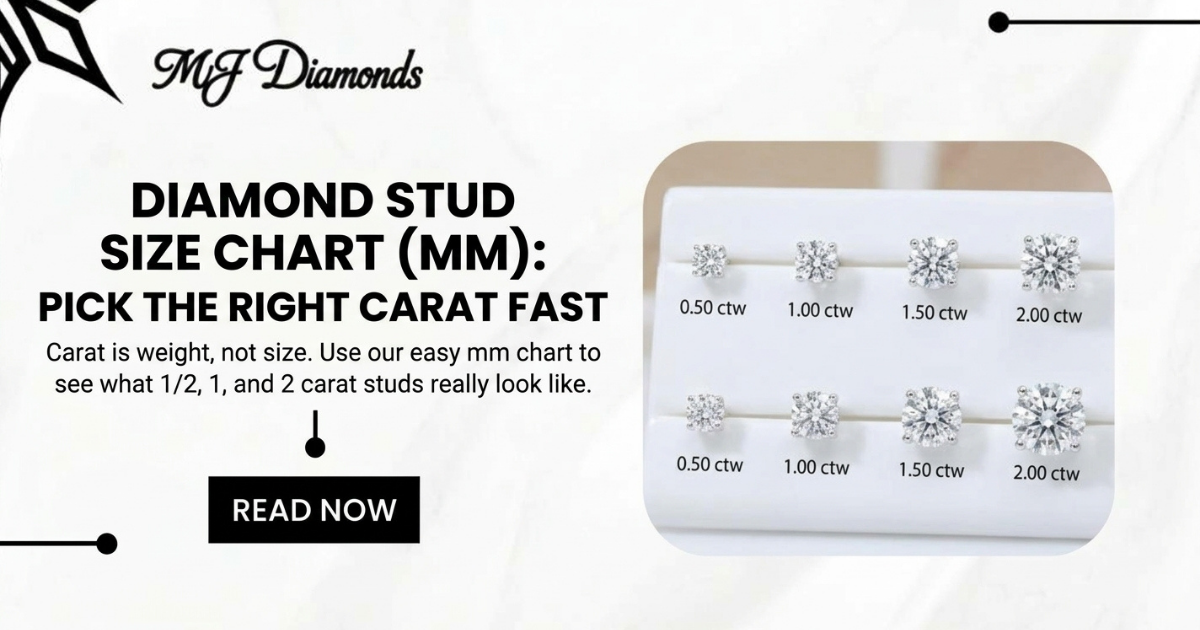
You are shopping for diamond studs. You see 1/2 carat, 1 carat, and 2 carat. But what does that look like on a real ear? Nobody wears a scale on their earlobe, so it is hard to tell.
Here is the problem. Carat is a measure of weight, not size. Two diamonds with the same weight can look a little different. And when you shop for studs, the weight is usually for the pair, not for each earring. That trips up a lot of shoppers.
This guide fixes that. You will get a simple chart in millimeters (mm), plain tips for picking a size, and answers to the questions people ask most. You do not need to know anything about jewelry.
The Short Answer
A pair of studs that weighs 1 carat total has two diamonds of about 1/2 carat each. Each diamond is about 5 mm wide. Many shoppers pick a total weight between 1/2 carat and 1 carat for everyday wear. Go bigger, at 1.5 to 2 carats and up, when you want a bolder look.
Carat vs. Total Carat Weight
Let’s clear up the biggest mix-up first.
A carat (ct) is a unit of weight. It tells you how much a diamond weighs. It does not tell you how wide the diamond is.
Studs come in pairs, so stores list the weight of both diamonds added together. You will see it written as ctw, tcw, or cttw. All three mean total carat weight.
Here is how it works:
- A 1 ctw pair has two diamonds of about 1/2 carat each.
- A 2 ctw pair has two diamonds of about 1 carat each.
- A 3 ctw pair has two diamonds of about 1 1/2 carats each.
So if you see “1 carat diamond studs” and picture a big 1 carat diamond in each ear, that is not what you get. You get two smaller stones that add up to 1 carat. That is why the pair looks smaller than many people expect. Always check whether a listing shows the weight per earring or for the pair.
Diamond Stud Size Chart (Carat vs. MM)
This chart shows round diamonds with a good cut. The sizes are close, not exact, because every diamond is a little different.
| Pair total weight | Each diamond | Width of each diamond | How it looks |
| 0.50 ctw | 1/4 carat | about 4.1 mm | Small and subtle |
| 0.75 ctw | 3/8 carat | about 4.6 mm | Light and neat |
| 1.00 ctw | 1/2 carat | about 5.1 mm | Classic everyday size |
| 1.50 ctw | 3/4 carat | about 5.8 mm | Easy to notice |
| 2.00 ctw | 1 carat | about 6.5 mm | Bold |
| 3.00 ctw | 1 1/2 carats | about 7.4 mm | Very bold |
| 4.00 ctw | 2 carats | about 8.2 mm | Statement size |
Use the second column to compare listings. Use the third column to picture the size on your ear.
Why Carat Weight Does Not Always Match Size
Weight and width are related, but they are not the same. Three things can change how big a stud looks.
- The cut. A diamond with a shallow cut spreads out wide across the top, so it looks bigger. A diamond with a deep cut hides some of its weight below the surface, so it looks smaller. Two round diamonds with the same weight can have different widths.
- The shape. Round is the most popular shape for studs, and it gives lots of sparkle. Other shapes, like oval and pear, can look larger than a round diamond of the same weight because they spread out more on top.
- The setting. A setting is the metal that holds the diamond. Some settings add width. A bezel wraps metal around the edge of the stone. A halo adds a ring of small diamonds. Both make the finished earring wider than the center diamond alone.
Here is the simple lesson. When you can, ask for the width of the diamond in mm, not just the weight. It tells you what you will really see.
What Each Size Looks Like on the Ear
1/2 carat total (about 4 mm each)
This size is small and quiet. It adds a little sparkle without drawing attention. It is a good first pair. It also works well for the office and for people who like light jewelry.
1 carat total (about 5 mm each)
This is the classic. It is large enough to see from across a table and small enough to wear all day. It holds about half a carat in each ear. That balance of sparkle and comfort is why so many people choose it.
1.5 carats total (about 6 mm each)
This size is easy to notice, but it is not loud. It is a nice step up from the classic. It works well for dressy days and for people who want their studs to show more.
2 carats total (about 6.5 mm each)
Now we are in bold territory. Each diamond is about the width of a 1 carat stone. People will notice. This size is popular for big birthdays, anniversaries, and other milestones.
3 carats total and up (7 mm or more each)
This is a statement size. It is best when you want your earrings to be the star of the outfit. Bigger diamonds also weigh more, so check that the earrings feel comfortable and stay in place.
How to Pick Your Size
There are no strict rules. But these ideas can make the choice easier.
Think about your ears and face. Small earlobes and delicate features often look balanced with 1/2 to 1 carat total. Larger lobes or a bolder style can handle 1.5 carats and up. If you wear your hair back or short, your earrings show more, so size stands out.
Think about how you will wear them.
- Every day and work: 1/2 to 1 carat total
- Dressy events: 1.5 to 2 carats total
- Big milestones: 2 carats total and up
- A second or third hole: Smaller studs, about 3 to 4 mm each, tend to sit better
Think about your budget. Price climbs fast as diamonds get bigger. A well-cut smaller pair often looks better than a larger pair with a weak cut. It is smart to pick the best cut you can afford first, and then choose the size.
Buying Diamond Studs as a Gift
Studs are one of the easiest gifts to give. They do not need a ring size, and they suit almost everyone. Here is how to choose with confidence.
- When you are unsure, go with 1/2 to 1 carat total. It is a safe, classic range.
- Pick round diamonds in a simple setting. They go with almost any outfit.
- Match the gold color she or he already wears. Look at their other jewelry to see if it is white, yellow, or rose gold.
- Check that their ears are pierced. Then check the return and exchange details on our return and exchange page before you buy.
Shopping for a holiday? Browse our Valentine’s Day picks or our Mother’s Day picks. You can also see ladies earrings for more ideas. Buying for him? Take a look at our men’s earrings, which include single studs and matched pairs.
Settings and Backs Change the Look
Two studs with the same diamond can look very different. The setting and the back both matter.
Prong setting. A four-prong setting holds the diamond up in small metal claws. It lets in the most light, so it gives the most sparkle.
Bezel setting. A bezel wraps a thin band of metal around the diamond. It is very secure, and it does not snag on hair or clothes. It has a clean, modern look. It can also make the earring look a little wider.
Earring backs. Most studs use a push back, which slides on the post. A screw back twists on and holds tighter. If you worry about losing an earring, ask which back comes with the pair.
Metal color. White gold looks cool and bright. Yellow gold looks warm. Rose gold has a soft pink glow. Our diamond earrings come in 10K and 14K white, yellow, and rose gold, and they are set with real diamonds.
Do You Need to Spend More on Clarity and Color?
Diamonds are graded on four things: cut, color, clarity, and carat weight. Clarity tells you how many tiny marks are inside the stone. Color tells you how white the stone looks.
Studs sit on your ear, and people see them from a few feet away. Because of that, tiny marks in a small diamond are hard to spot. Many shoppers put more of their budget toward cut and size. Cut controls how much the diamond sparkles, so it is a smart place to invest.
The best way to check is to compare pairs side by side. Ask a jeweler to show you a few options under the store lights. Your own eyes will tell you what looks best.
Try a Size at Home With a Real Ruler
You can test a size before you buy. Just do not use a chart on your phone or computer. Screens change size, so a circle on a screen is not a true mm size.
Try this instead:
- Grab a ruler with mm marks.
- Cut a small paper circle to the width you want, such as 5 mm.
- Hold it against your earlobe in a mirror.
- Try a few sizes and see which one you like.
Here is a fun tip. Many hole punches make a dot about 1/4 inch wide. That is about 6.4 mm, which is close to the width of a 1 carat round diamond. It is a quick way to see a 2 carat total weight pair.
Five Mistakes to Avoid
- Thinking 1 ctw means 1 carat in each ear. It means the pair adds up to 1 carat.
- Judging size by carat alone. Check the mm width too.
- Ignoring the setting. A bezel or halo can make the earring look bigger.
- Going too big for daily life. Very large studs can feel heavy and may catch on hair or scarves.
- Buying from a chart only. Try a few sizes in person when you can.
Frequently Asked Questions
What size diamond stud earrings are most popular?
Many shoppers choose between 1/2 and 1 carat total weight. It is big enough to see and small enough to wear every day. It is a safe pick for a first pair or a gift.
What does 1 carat total weight look like in studs?
It looks like two round diamonds, each about 5 mm wide. The look is neat and classic, not flashy. You will notice the sparkle, but the earrings will not take over your face.
Is 1 carat total weight too small?
No. It is a popular everyday size. If you want something bolder, look at 1.5 or 2 carats total. It all comes down to the look you like.
How many mm is a 1 carat diamond earring?
A single round diamond of 1 carat is about 6.4 to 6.5 mm wide. That would be a 2 carat total weight pair. For a pair that weighs 1 carat total, each diamond is about 5.1 mm wide.
Are 2 carat total weight studs too big?
Not for most people. Each diamond is about 6.5 mm wide. That is bold, but many people wear this size every day, especially in a low, secure setting. If you like a quieter look, choose a smaller pair.
Does a bigger carat weight cost more?
Yes. Larger diamonds cost more, and the price climbs faster as the size grows. The quality of the cut matters too. A well-cut smaller diamond can look more brilliant than a larger one with a poor cut.
Ready to See the Sizes in Person?
A chart is a great start, but nothing beats seeing studs on your own ear. Browse our diamond stud earrings to see what is available. You can also explore huggies and hoops if you want a different style.
Then visit one of our showrooms across Metro Detroit and Ann Arbor. You can find the closest one on our locations page. Want a hand? Book a shopping appointment or contact us. Our team can show you sizes side by side and help you pick the right pair.